
Machine Learning for Industrial Data (SAFI M8ML)
21 HEURES (3 JOURS)
FORMATION EN DISTANCIEL
DE 1250 € à 2200 €HT
Overview
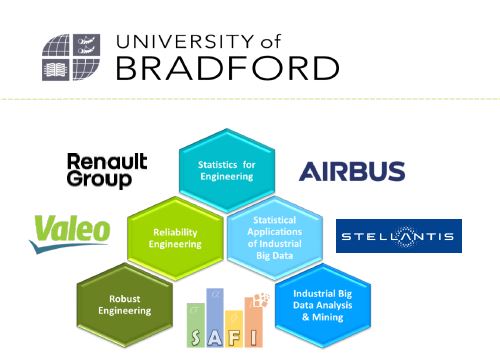
This intensive CPD course is designed for industry professionals working across business, engineering, project and product lifecycle management roles. It provides a fast-track route to acquiring practical skills in the applications of machine learning techniques to different problems and use cases, enabling participants to boost their effectiveness with AI applications for real business impact. The course was developed and validated in close collaboration between experienced academic and industry professionals from the global automotive and aerospace sectors (the SAFI consortium), ensuring the curriculum fully reflects current industry best practice in skills and capability development.
Learning Outcomes
- Master understanding of machine learning based on artificial neural networks, the underpinnings of language models and knowledge engineering for industrial AI applications
- Confidence in selection and implementation of machine learning techniques for practical AI applications in the workplace
- Skills in practical use of Python coding, implementing workflows and methodologies appropriate for the data and problem context
- Interpret and explain results to a range of audiences including non-specialists, lead effectively industrial AI implementation
Pre-requisites
Prior attendance of SAFI M6-1 “Statistics & Data Science for Industry” is recommended, or equivalent knowledge and experience with statistical learning and data analytics application, along with basic Python coding skills.
This course is intended for professionals who:
- This course is intended for professionals who:
- Wish to gain practical skills in machine learning for intelligent industrial applications
- Want to leverage AI and data-driven modelling for business decisions and applications
- Are looking to upskill with a structured, industry- validated and Qualiopi accredited course
Fundamentals of Machine Learning
- Fundamental underpinnings for neural networks, machine learning and artificial intelligence
Classification with Machine Learning
- Neural network algorithms used for classification problems with real world application examples
Continuous Data Machine Learning Models
- Introduction to Gaussian Kriging and Radial-basis functions Neural Networks with industrial use
cases for model building and validation
Deep Learning – applications for Computer Vision
- Introduction to deep learning convolutional neural networks; application to computer vision
for manufacturing process
Language models
- Natural Language Processing, learning-based models and Large-Language Models (LLMs)
Introduction to Knowledge Graphs
- Overview of knowledge graphs and ontologies applied to industrial knowledge management, with embedded agentics.
Mini Project
- Independent practice through application to a an industrial data challenge
The 3-day course is delivered in a workshop format, with an approximate 40/60 split between technical sessions and hands-on tutorials and exercises.
Practical engineering case studies provide the context for explaining key concepts and the application of methods and algorithms. Daily technical keynotes from industry experts provide real-world context of application.
“Open” courses are delivered on line.
PROCHAINE(S) SESSION(S)
Nous consulter 17-18-19 juin 2026 & 25-26-27 nov 2026
ACCESSIBILITÉ
Les personnes en situation de handicap sont invitées à contacter notre Référent Handicap afin d'étudier ensemble les possibilités de suivre la formation.
ENVOYER UN EMAIL